Blood in the Dark: What the Iranian Regime Reveals About Political Islam
How Islam Turns Power into Blood
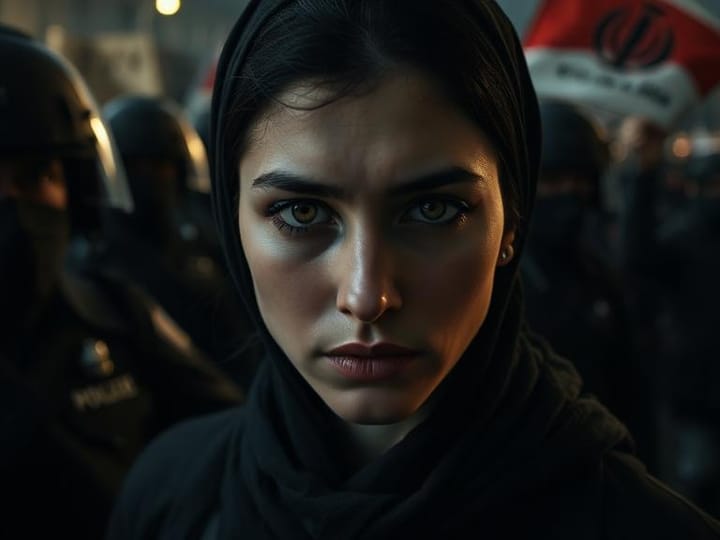
For more than four days, Iran disappeared from the digital world.
No internet. No messages. No calls. Only silence—broken by gunfire.
The official reason was “security.”
The real reason was simpler: the regime wanted to kill in the dark.
When a government shuts down the internet while shooting its own people, it is not “maintaining order.” It is trying to erase witnesses.
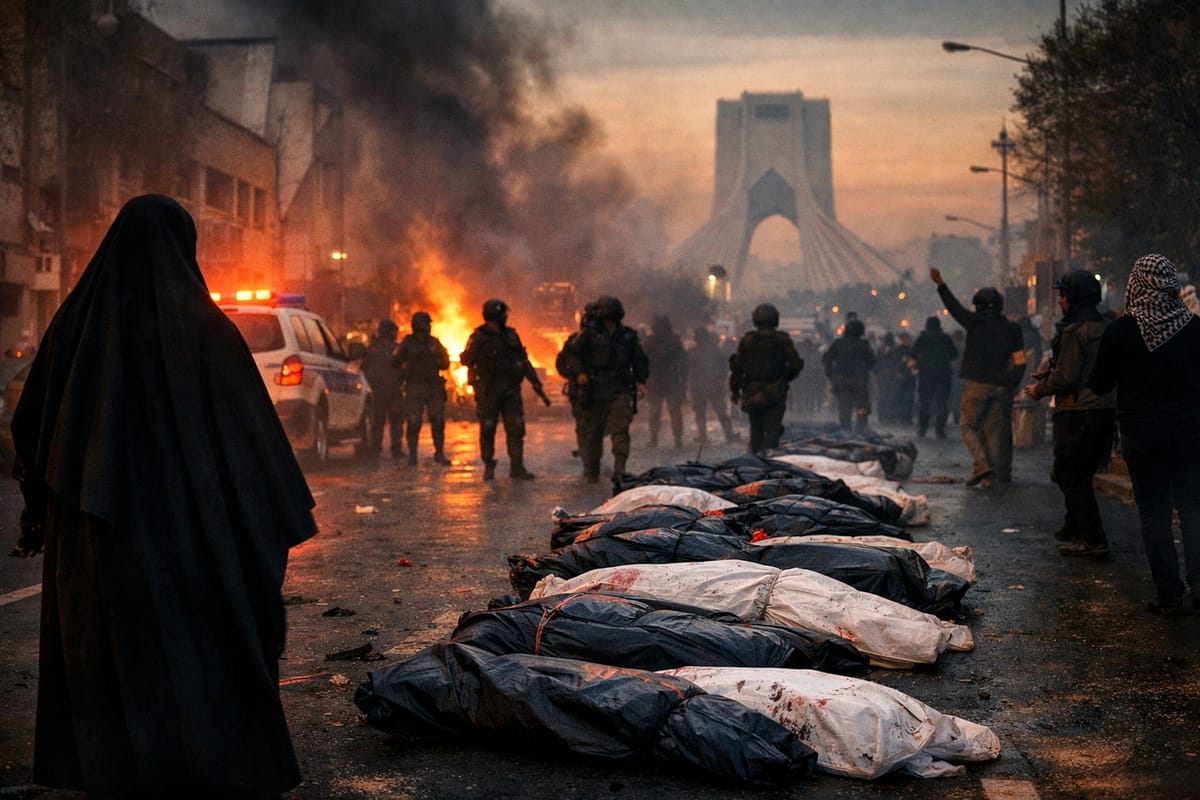
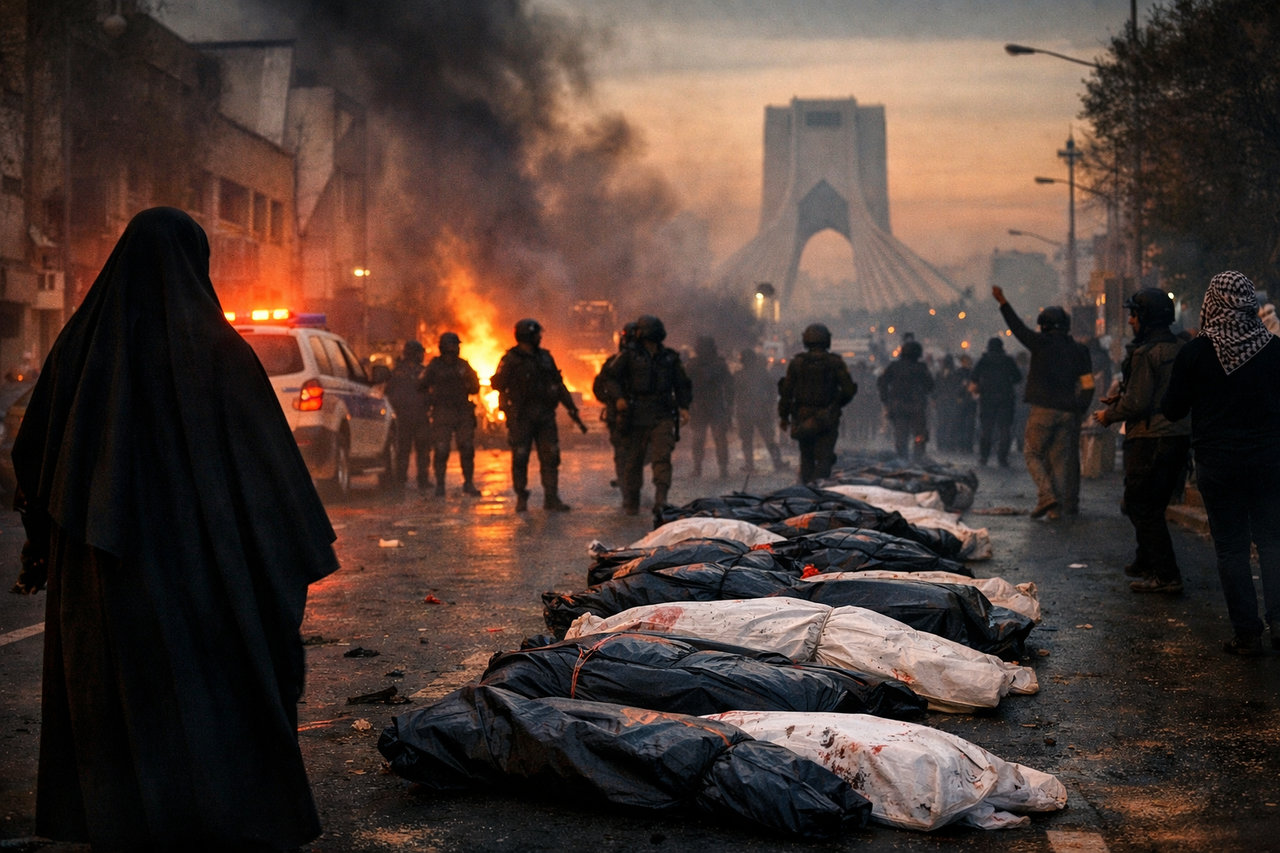
Despite the blackout, fragments escaped: videos, voices, bodies in bags. Streets lined with corpses near forensic centers. Witnesses describing warehouses filled with fresh dead. Doctors reporting patients with their eyes shot out. Security forces firing hundreds of rounds into crowds. Human rights groups estimating between 2,500 and possibly far more than 10,000 dead.
This is not a “cultural misunderstanding.”
This is not “Western bias.”
This is the logical outcome of a political system built on radical Islamist power.
The Structure of Violence
Iran is not simply a dictatorship.
It is a theocracy—rule by religious authority.
Real power does not lie with voters, parliaments, or courts. It lies with clerics who claim divine legitimacy. When power is justified by God, opposition is no longer political—it becomes heresy.
And heresy must be crushed.
That is why protesters are not treated as citizens with grievances, but as enemies of God.
That is why bullets are fired into crowds.
That is why bodies are hidden, and families are silenced.
Political Islam does not merely govern—it sanctifies power.
And when power is sacred, cruelty becomes a duty.
Why the Internet Had to Die
Every authoritarian state fears cameras.
Every theocratic state fears truth even more.
The Iranian regime did not cut the internet because it was losing control. It cut the internet because it knew what control would require.
It knew that the coming crackdown would be too brutal to show the world.
So it chose darkness.
In that darkness, men were shot.
In that darkness, bodies were moved.
In that darkness, mothers searched for daughters who would never return.
This is not an accident of history. It is a system working as designed.
Islam as Faith vs. Islam as Power
Criticizing the Iranian regime is often dismissed as “Islamophobia.” That accusation is a lie designed to protect power.
There is a difference between:
- Islam as a personal faith, and
- Islam as a political weapon.
Millions of Muslims live peacefully, lawfully, and humanely. They are not the problem. The problem is what happens when religion becomes the state—and the state becomes untouchable because it claims divine authority.
When clerics rule, dissent becomes blasphemy.
When blasphemy becomes treason, killing becomes justice.
That is not spirituality.
That is tyranny wearing a holy costume.
Why the West Hesitates
Western leaders talk endlessly about “dialogue,” “de-escalation,” and “cultural sensitivity.” Meanwhile, bodies pile up.
Why?
Because criticizing political Islam is dangerous in Western discourse. It risks being labeled racist, colonial, or hateful. So leaders speak in vague phrases while regimes kill in clear actions.
But silence is not neutrality.
Silence is collaboration with power.
Every time Western governments speak softly while clerics shoot loudly, they send one message to Tehran:
“You can kill, and we will talk.”
Fear as a Political Tool
The Iranian regime understands something many democracies have forgotten: fear works.
High death tolls are not hidden only out of shame. Sometimes they are displayed as warnings. Even regime-friendly sources speak of thousands dead—not to confess, but to intimidate.
The message to citizens is simple:
“Look what happens when you resist.”
That is not weakness.
That is calculated terror.
Political Islam thrives on fear because fear feels like reverence. People who are afraid do not argue. They obey.
The Myth of Reform
For decades, the West hoped for “moderate” clerics, “reformist” factions, “pragmatic” Islamists. The streets of Tehran now answer that illusion.
When the system itself is built on sacred power, no leader can truly reform it. Any reform that weakens religious authority is, by definition, heresy. And heresy cannot be allowed to survive.
You cannot humanize a system that believes it answers to God instead of people.
What This Means Beyond Iran
Iran is not an isolated case. It is a warning.
Wherever religion becomes law, and law becomes unquestionable, violence follows. It may be slower. It may be quieter. But it always arrives.
Political Islam is not dangerous because Muslims exist.
It is dangerous because power claims holiness.
And holy power never apologizes.
The Real Question
The images from Tehran—body bags, gunfire, blind eyes—are not just about Iran. They ask a question to the entire world:
How many bodies does it take before we admit that the problem is not “mismanagement,” but ideology?
Not culture.
Not ethnicity.
Not people.
Ideology.
An ideology that says power comes from God, not from citizens.
An ideology that treats dissent as sin.
An ideology that sees blood as a tool of purification.
Conclusion: Darkness Has a Name
The Iranian regime wants darkness because darkness hides responsibility.
But darkness also reveals something else: what a system really is when it no longer needs to pretend.
What we see now is political Islam without its mask.
Not misunderstood.
Not misrepresented.
Not “complex.”
Just what it has always been when fully unleashed:
A system that kills in God’s name—and calls it order.
Comments ()