
Power Without Mandate
How NGOs Reshaped Western Decision-Making
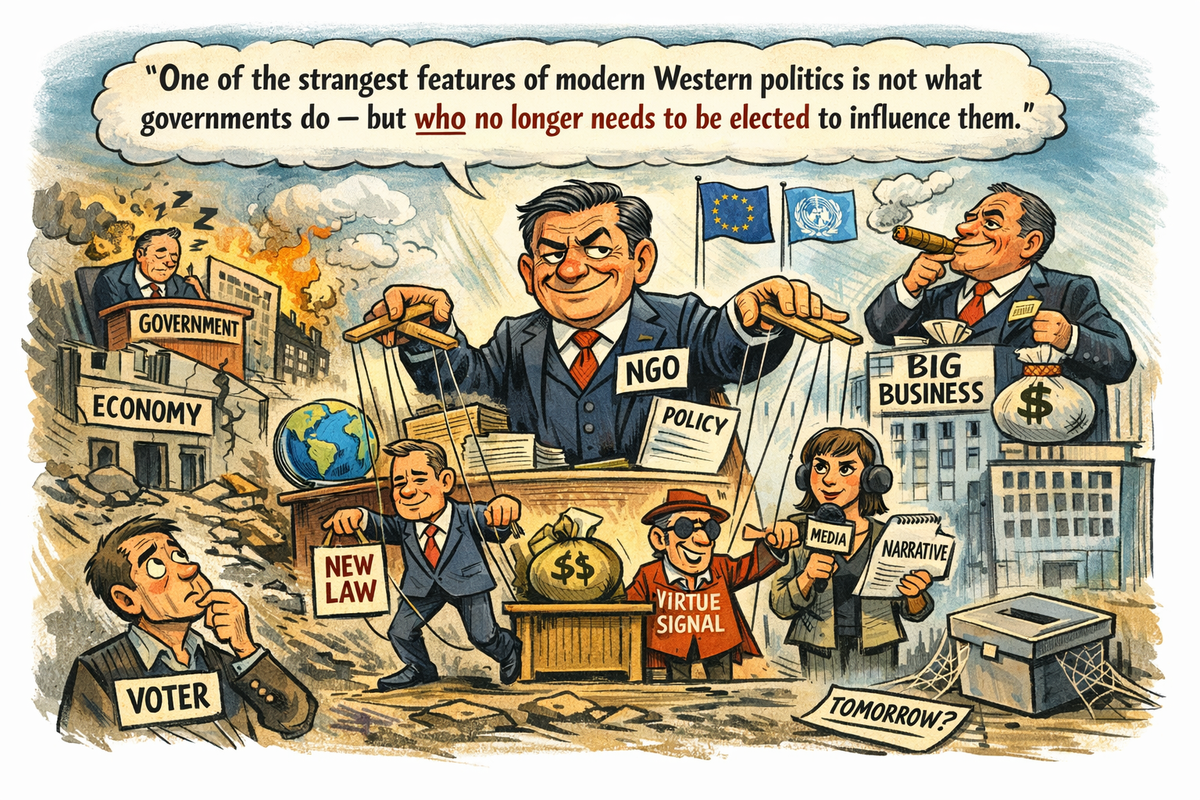
One of the strangest features of modern Western politics is not what governments do — but who no longer needs to be elected to influence them
When policies repeatedly produce economic strain, social fragmentation, and cultural conflict, the obvious question arises: Why does this continue?
Is it incompetence? Ideology? Fear of backlash?
Or is power now exercised through actors who carry influence without accountability?
This is where NGOs enter the picture — not as villains, but as a structural force we have failed to examine honestly.
The Rise of Moral Authority
Non-governmental organizations were once limited in scope and ambition. Many performed essential humanitarian, environmental, or civil society functions. Some still do.
But over the past three decades, NGOs have undergone a quiet transformation.
They have become policy entrepreneurs, narrative engines, and moral gatekeepers — operating between governments, media, and international institutions.
They are not elected.
They do not govern.
They rarely face consequences when policies fail.
Yet they increasingly shape:
- legislative priorities
- public language
- acceptable opinions
- corporate compliance standards
- international norms
This is not conspiracy. It is institutional evolution.
The Accountability Gap
In a functioning democracy, power is supposed to come with three things:
- A mandate
- Responsibility
- Consequences
NGOs operate with none of these.
They recommend policies but do not implement them.
They advocate outcomes but do not manage costs.
They shape narratives but are insulated from voter backlash.
When a policy succeeds, NGOs claim moral credit.
When it fails, responsibility dissolves into bureaucracy.
This creates a structural imbalance: influence without liability.
The NGO–Government–Media Loop
Modern governance increasingly follows a predictable pattern:
- An NGO defines a moral problem
- Media outlets amplify the framing
- Politicians respond with symbolic urgency
- Policies are rushed or insulated from criticism
- Negative consequences are labeled “unfortunate but necessary”
- NGOs demand expanded authority to fix the damage
The loop closes. No one is personally accountable. Everyone appears morally aligned.
This is not coordination in a secret room.
It is alignment through incentives.
Moral Outsourcing
Politicians today face a problem: voters are fragmented, media cycles are brutal, and long-term thinking carries short-term risk.
NGOs offer an escape.
By deferring to “experts,” “civil society,” or “international standards,” leaders outsource moral responsibility. Decisions are no longer framed as political choices — but as ethical imperatives.
Disagreement becomes immorality.
Criticism becomes extremism.
Debate becomes dangerous.
This is how democracy erodes quietly — not through dictatorship, but through moral insulation.
Funding, Influence, and Silence
Another uncomfortable question is rarely asked in public discourse:
Who funds NGOs — and why?
Governments fund NGOs.
Corporations fund NGOs.
Foundations fund NGOs.
International institutions fund NGOs.
Each comes with priorities, expectations, and ideological alignment.
This does not automatically imply corruption.
But it does create dependence, conformity, and narrative discipline.
Organizations that challenge dominant frameworks risk losing access, funding, or legitimacy. Those that reinforce them are rewarded.
This is how ideological ecosystems stabilize without overt censorship.
Why Failure Is Never Punished
When government programs fail, elections can change leadership.
When corporations fail, markets impose consequences.
When NGO-driven policies fail, something remarkable happens:
the failure becomes justification for more of the same approach, implemented with greater urgency and less scrutiny.
The public pays the cost.
The institutions retain the authority.
This asymmetry explains why destructive outcomes can persist without correction — not because anyone desires collapse, but because no one is structurally incentivized to stop it.
Is This a “Deep State”?
The term is emotionally charged and often misused.
There is no need to posit a centralized cabal.
What exists instead is distributed power without democratic feedback.
Call it:
- soft power without mandate
- governance by moral proxy
- institutional capture through incentives
It is less dramatic than conspiracy — and far more dangerous.
After Us, the Flood
Perhaps the most troubling aspect of this system is its time horizon.
NGOs are rewarded for visibility, urgency, and moral clarity — not long-term societal cohesion.
Politicians are rewarded for appearing compassionate today — not for preventing problems tomorrow.
The costs accumulate slowly, invisibly, and unevenly.
Those least able to absorb them pay first.
Responsibility evaporates.
Language hardens.
Questions become forbidden.
And the citizens are told this is progress.
The Question We Must Ask
This is not an argument against NGOs as such.
Nor is it a defense of any political camp.
It is a call to restore a basic democratic principle:
Power must answer to consequences.
If NGOs shape policy, they must be scrutinized.
If morality drives law, it must tolerate dissent.
If institutions claim authority, they must accept responsibility.
Otherwise, we are no longer governed — we are managed.
And management without accountability always ends the same way.
Not with tyranny.
But with decay justified as virtue.


Comments ()