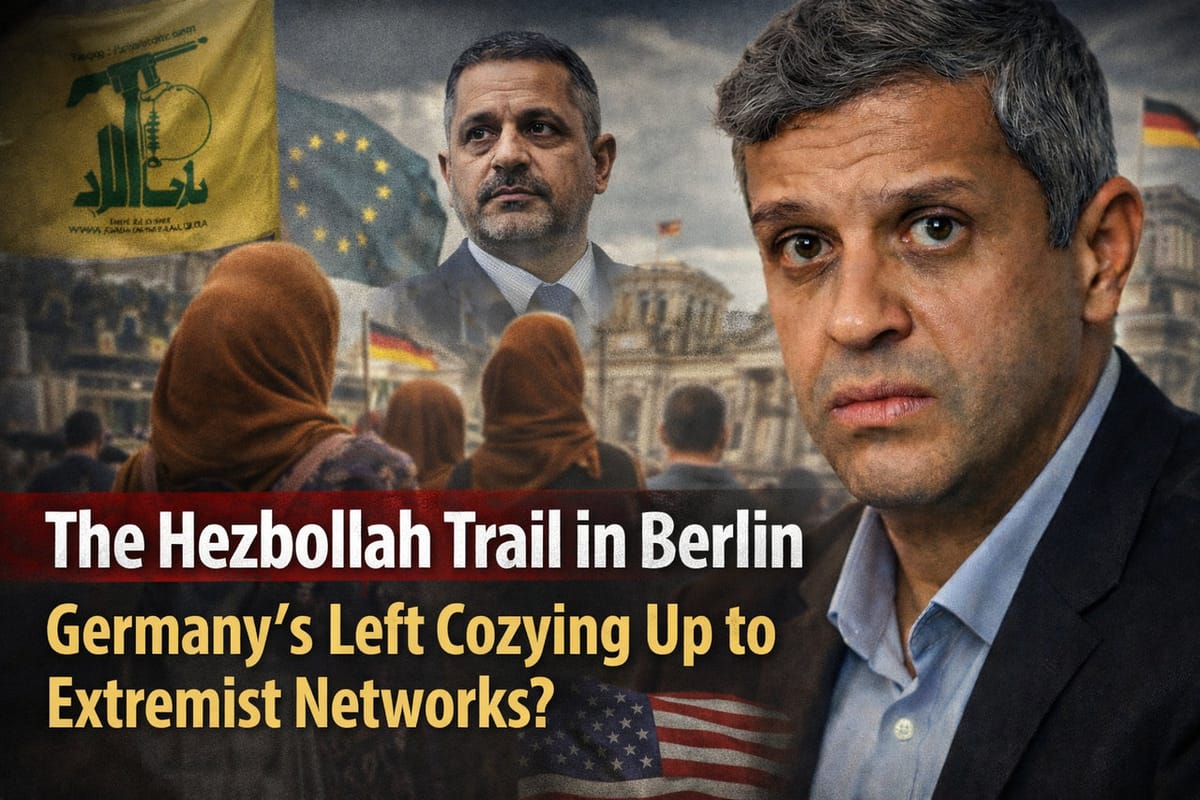
The Hezbollah Trail in Berlin
How Germany’s Political Power Circles Drift Toward Extremist Networks
Berlin is often presented as the capital of tolerance, democracy, and openness.
But a recent investigation forces a disturbing question:
How close is political power in Germany’s capital to networks that glorify terrorist organizations?
This report is based on documented research by German journalist Felix Perrefort (Jan 8, 2026). What follows is not speculation, but reconstruction — built on photos, public websites, and open-source material.
What Hezbollah Means
Hezbollah is not a protest group.
It is a terrorist organization.
Founded in 1982 with support from Iran’s Revolutionary Guard, Hezbollah has carried out:
- The 1983 Beirut bombings killing over 300
- The 1994 AMIA Jewish center attack in Argentina (85 dead)
- The 2012 Burgas bus bombing in Bulgaria
- Ongoing rocket attacks on Israel
Germany classifies both the political and military wings of Hezbollah as terrorist.
Glorifying Hezbollah means legitimizing terror.
The Power Figure: Raed Saleh
Raed Saleh has been leader of Berlin’s Social Democratic parliamentary group since 2011.
He is one of the most powerful politicians in the German capital.
The investigation does not accuse him of supporting terrorism.
It asks something more uncomfortable:
Who surrounds him — and what kind of networks operate around his power?
The Connector: Abed Khattar
Central to the network is media activist Abed Khattar.
For over a decade he has run a website documenting Arab-Islamic political and cultural events in Berlin.
On this site:
- Numerous photos show Khattar alongside Saleh over many years
- Khattar appears regularly at SPD party events
- He is treated as a normal figure inside political circles
But the same site also shows Khattar:
- With a Hezbollah politician named Sahili Nawar
- Honoring him as an “Excellency”
- Posing with symbols linked to extremist Palestinian factions
- Appearing at events tied to banned networks like Samidoun
Samidoun is classified as extremist in Germany and linked to the PFLP, itself designated terrorist.
The Hezbollah Politician
One image shows Khattar with Sahili Nawar, a Hezbollah politician.
At an event, Nawar is honored as a special guest.
Why is a politician from a terrorist organization welcomed at events connected to Berlin-based networks?
Even more troubling:
In 2016, Saleh and Khattar appear together at an SPD event — showing how close political power and this activist already were at that time.
There is no direct Saleh-Hezbollah link.
But there is a human bridge.
The NGO Networker
The third figure is Jamal El Moghrabi.
He has held leadership roles in several Arab-German organizations and NGOs.
According to the investigation:
- He links NGOs, cultural groups, and political access
- His organizations often operate only in Arabic
- Integration into German civic life appears secondary to building parallel structures
The triangle becomes clear:
- Saleh = political authority
- Khattar = media and visibility
- Moghrabi = organizational networks
And through Khattar, lines reach extremist milieus.
Inside Political Circles
Khattar is not marginal.
Photos show him with:
- Raed Saleh
- Former Berlin mayor Michael Müller
- Other senior SPD figures
He is welcomed inside elite political events — while simultaneously glorifying extremist groups.
When asked about this, Saleh did not respond to journalists.
Why This Matters to America
Germany is a core NATO member.
Berlin is one of Europe’s political nerve centers.
If extremist networks can move through:
- Political circles
- NGO systems
- Cultural institutions
without serious scrutiny, this becomes a Western security problem — not just a German one.
Democracies do not fall only through tanks and coups.
They fall through:
- Blindness to infiltration
- Fear of asking hard questions
- Political convenience replacing vigilance
The Real Question
This is not about ethnicity.
Not about religion.
Not about culture.
It is about loyalty — and who verifies it.
In thrillers, the “sleeper agent” is planted early, ignored, normalized, and activated later.
In the real world, influence is built quietly — through networks, loyalty chains, and ideological affinity.
China uses demographic and network strategies to dominate regions.
Iran uses proxy movements to expand influence.
Extremist movements rely on social cover, not uniforms.
So the question is unavoidable:
Who systematically checks constitutional loyalty in mass-migration societies?
Who examines not just documents, but ideological ties — when people rise into power, NGOs, media, and politics?
Because democracies rarely collapse loudly.
They usually collapse politely — while telling themselves nothing is wrong.