
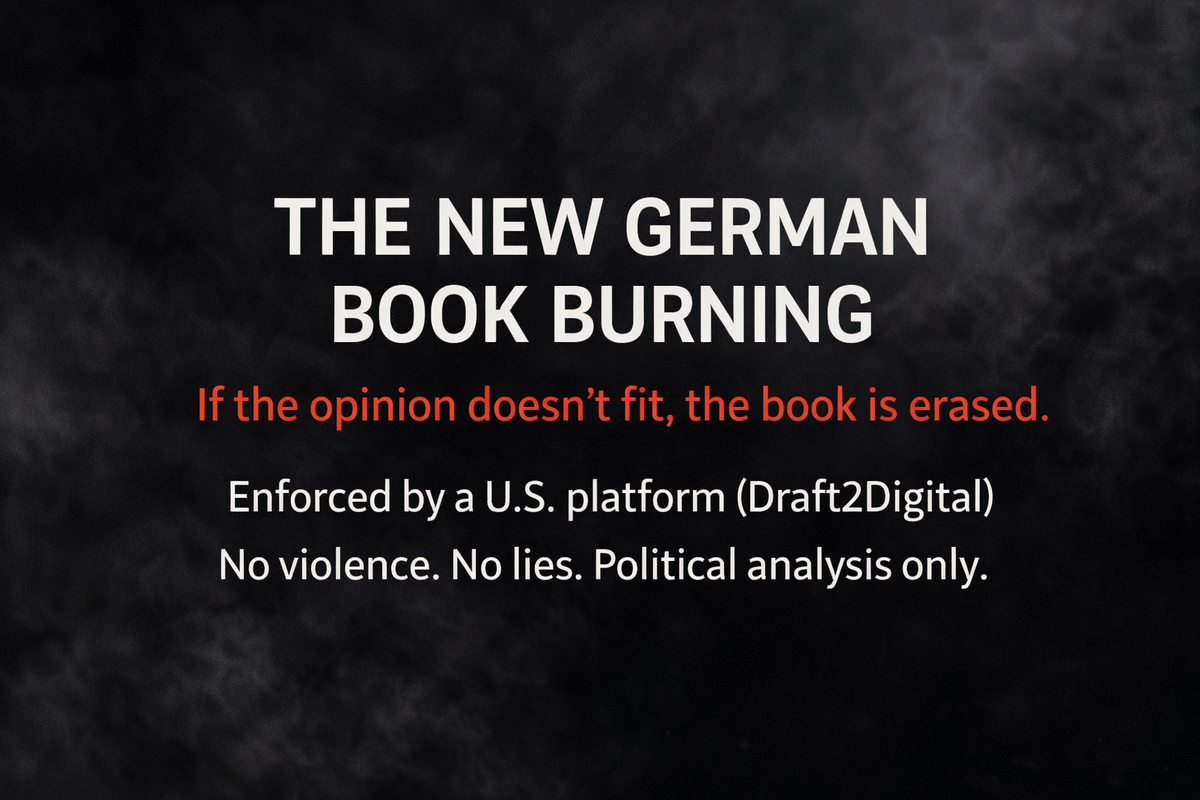
The New German Book Burning
No flames. No courts. Just platform policies.
For years, American politicians have warned that freedom of speech in parts of Europe is under growing pressure. Those warnings were often dismissed as exaggeration, culture-war rhetoric, or partisan framing.
Recent events suggest otherwise.
After the publication of my book Feindbild AfD — a political analysis of how Germany’s Alternative für Deutschland functions as a symbolic enemy within public discourse — my books were removed from distribution across major German retail channels. This did not happen through a court ruling, a government order, or a finding of illegality.
It happened quietly, digitally, and contractually.
The enforcement was carried out by Draft2Digital, a U.S.-based ebook distribution platform. Not only was the title in question removed, but all of my books were taken down at once, including Fire in the Holy Land, a pro-Israel analysis, and Imported Hate. Because the publications were distributed through a friend’s account, her entire catalog was removed as well.
No individual review.
No title-by-title assessment.
No allegation of violence, hate speech, or false factual claims.
Just collective removal.
Let me be clear about something that is often deliberately blurred:
I am not a member of the AfD, nor do I write party advocacy. My position — stated repeatedly and openly — is that banning political parties or suppressing political analysis is incompatible with democratic principles. That position alone was sufficient to trigger deplatforming.
This is not a story about one book. It is a case study in how modern censorship operates.
In 2025, books are not burned in public squares. They are made unavailable through platform policies, risk management frameworks, and opaque enforcement decisions by private intermediaries. Responsibility is diffused, accountability disappears, and the outcome is the same: access is denied.
What makes this case particularly telling is the transatlantic dimension. A U.S. company, operating under U.S. law, implemented restrictions aligned with the most restrictive political sensitivities of the German market. No government needed to intervene. No formal ban had to be issued.
This is how speech control now works.
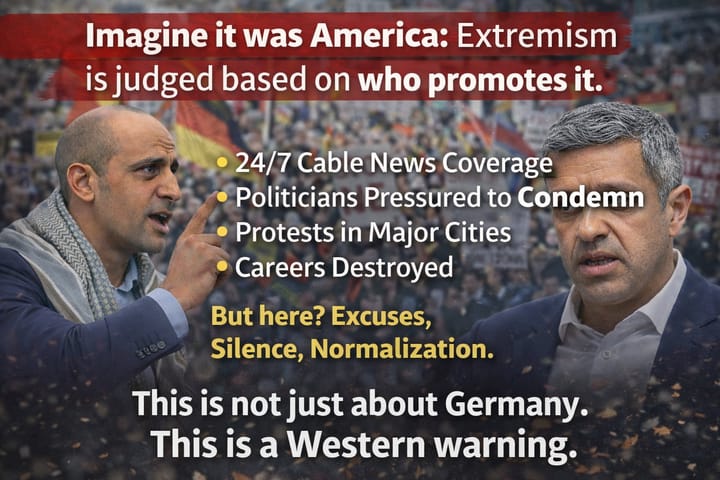
When figures like J.D. Vance or Donald Trump criticize Germany’s approach to speech and dissent, many Europeans react defensively. But criticism should not be evaluated based on who voices it. It should be evaluated against reality. And the reality is this: when political analysis leads to collective removal of lawful books, concerns about democratic resilience are no longer abstract.
They are observable.
The question is no longer whether free speech is formally protected. It is who controls access, who defines acceptable analysis, and how quietly exclusion can be implemented without public debate.
That is why this matters — not just for authors, but for anyone who believes that democracy depends on open, uncomfortable, and contested discourse.

Comments ()