
When Self-Destruction Becomes Policy
PART 1 — GERMANY When Self-Destruction Becomes Policy
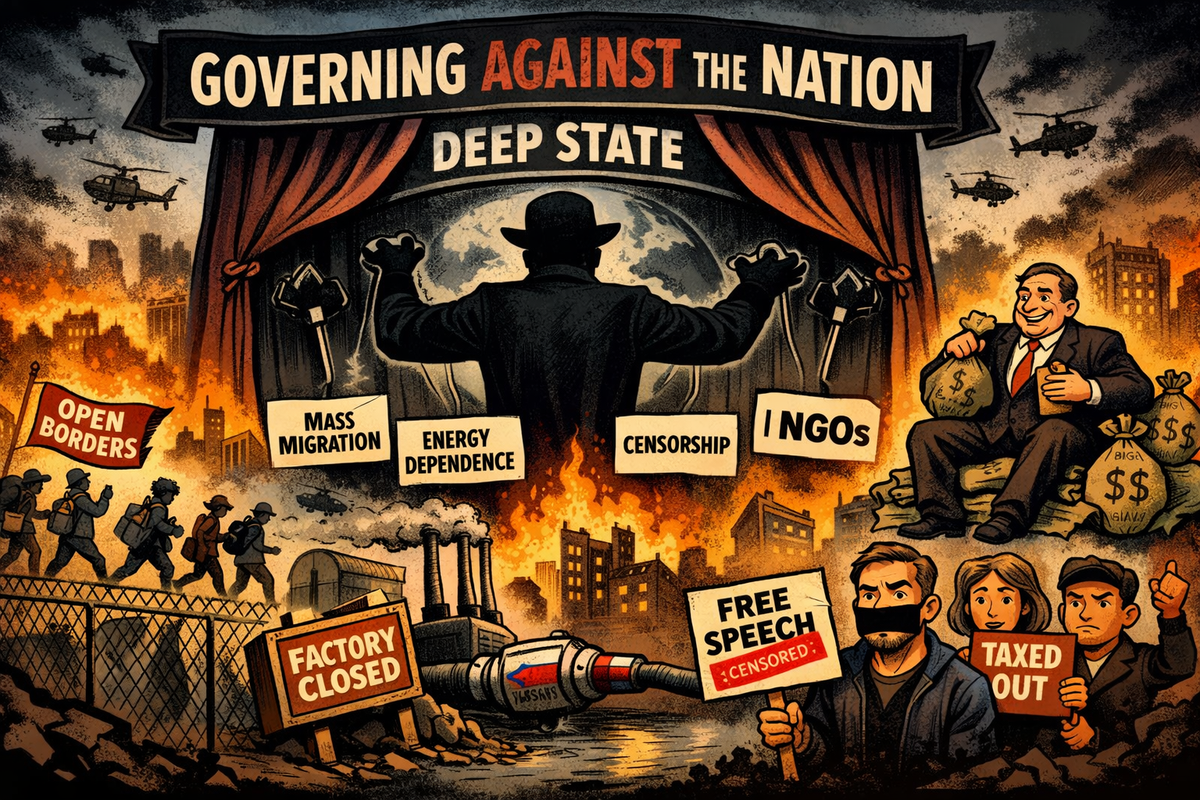
This essay does not claim conspiracy.
It examines incentives, data, and accountability gaps.
Germany as a Case Study in Power Beyond Elections
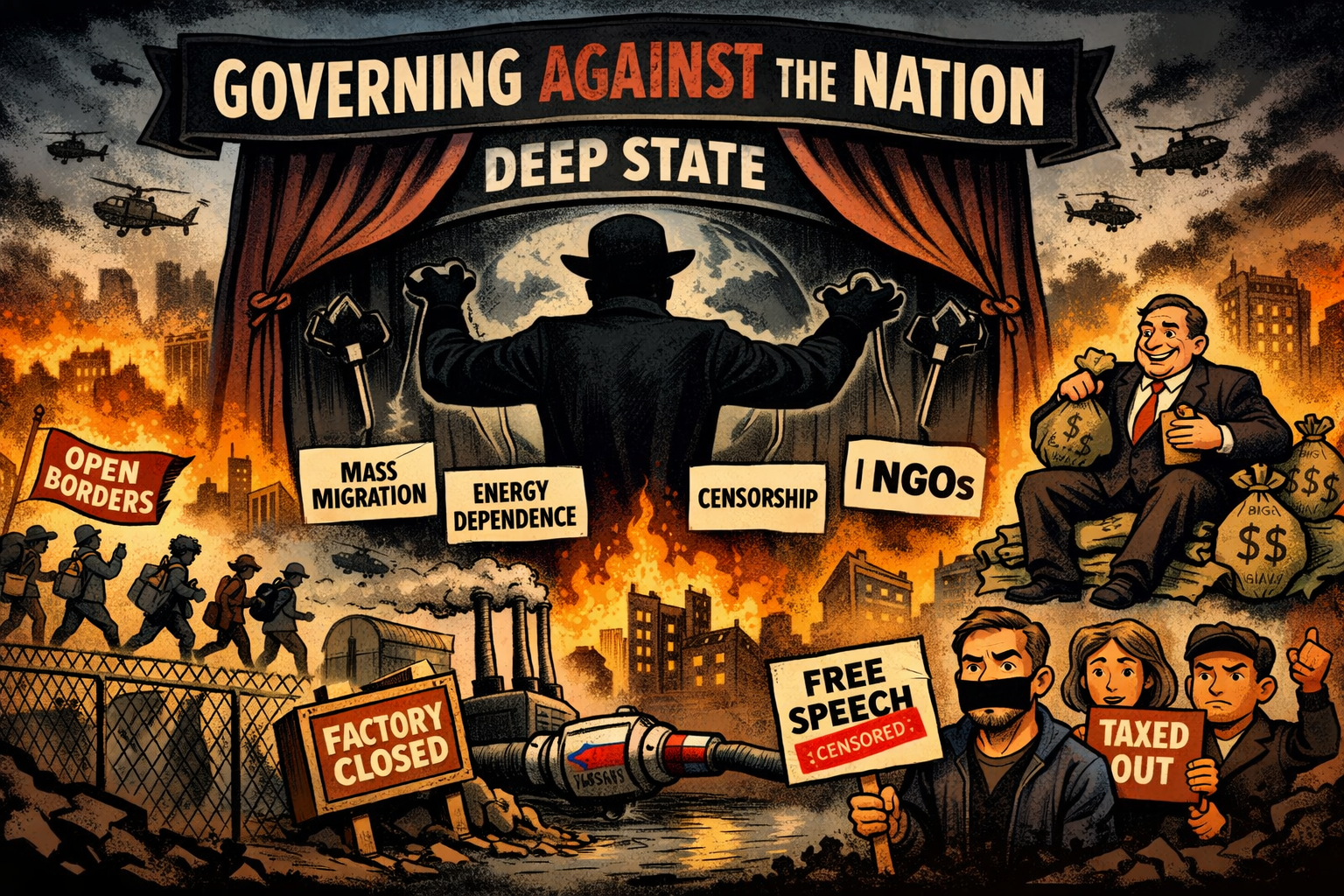
This essay does not allege conspiracy.
It examines data, incentives, and accountability gaps.
When wealthy, stable democracies repeatedly adopt policies that weaken their own economic base, strain social cohesion, and reduce strategic autonomy, coincidence becomes an insufficient explanation.
Germany is a particularly clear case.
Over the last decade, the country pursued three major policy trajectories simultaneously:
mass migration without direct democratic mandate, strategic energy dependence despite warnings, and expanding speech regulation framed as moral necessity.
Each decision was justified individually.
Together, they form a pattern.
The question is not who planned this, but why correction never occurs.
Mass Migration Without Explicit Democratic Consent
Between 2015 and 2023, Germany experienced the largest migration inflow in its postwar history.
Net migration peaked in 2022 at over 1.4 million people, driven by asylum migration, temporary protection, and family reunification. In total, more than seven million migrants entered the country over that period.
This demographic shift occurred without a national referendum or explicit electoral mandate on scale, speed, or capacity limits.
Measured outcomes are no longer disputed:
housing shortages intensified, education and welfare systems came under strain, and integration into skilled employment lagged significantly in the first years after arrival.
Despite these indicators, policy direction did not materially change.
Sources – Migration
- German Federal Statistical Office (Destatis), Migration & Integration
https://www.destatis.de/EN/Themes/Society-Environment/Population/Migration-Integration/_node.html - OECD, International Migration Outlook
https://www.oecd.org/migration/international-migration-outlook/ - Institute for Employment Research (IAB), labor market integration studies
https://www.iab.de/en/ - German Federal Court of Auditors (Bundesrechnungshof), migration cost assessments
https://www.bundesrechnungshof.de
Energy Dependence Against Strategic Logic
Prior to 2022, Germany sourced roughly 55 percent of its natural gas and over one-third of its oil from Russia, while simultaneously dismantling its domestic nuclear power capacity.
These choices were made despite years of documented warnings from security experts, NATO-aligned assessments, and EU-level strategic reviews.
The consequences were immediate and measurable:
energy prices surged by 200–300 percent at peak, energy-intensive industries curtailed production or relocated, and Germany’s industrial competitiveness deteriorated.
The risks were foreseeable.
The outcomes were predicted.
Political accountability did not follow.
Sources – Energy
- German Ministry for Economic Affairs and Climate Action (BMWK)
https://www.bmwk.de
- International Energy Agency (IEA), Germany profile
https://www.iea.org/countries/germany - Bundesnetzagentur (Federal Network Agency)
https://www.bundesnetzagentur.de
- European Commission, energy dependency reports
https://energy.ec.europa.eu
Deindustrialization Framed as Moral Progress
Germany’s manufacturing sector has steadily declined as a share of GDP while regulatory, compliance, and ESG-related burdens increased.
Major industrial actors publicly warned of reduced competitiveness and shifted investment toward the United States and Asia after 2021. Capital outflows accelerated, particularly in chemicals and heavy industry.
These developments were not framed as economic warning signs, but as transitional costs of moral leadership in climate and regulatory policy.
Costs were absorbed by workers, consumers, and small-to-medium enterprises — not by decision-makers.
Sources – Industry
- OECD, Economic Outlook
https://www.oecd.org/economic-outlook/ - German Chamber of Industry and Commerce (DIHK)
https://www.dihk.de
- Deutsche Bundesbank, capital flow statistics
https://www.bundesbank.de
- BASF public statements and disclosures
https://www.basf.com/global/en/media.html
Speech Regulation as System Stabilization
Germany expanded legal and administrative controls on speech, particularly online, through criminal law provisions and platform enforcement obligations.
These measures were justified as historical responsibility and democratic protection.
At the same time, public trust in media fell below 50 percent, political disengagement increased, and alternative media consumption rose.
Regulation did not restore trust.
It reduced contestation.
Sources – Speech & Media
- German Criminal Code (Strafgesetzbuch)
https://www.gesetze-im-internet.de/stgb/ - Network Enforcement Act (NetzDG)
https://www.gesetze-im-internet.de/netzdg/ - Reuters Institute, Digital News Report
https://www.digitalnewsreport.org
- EU Digital Services Act
https://digital-strategy.ec.europa.eu/en/policies/digital-services-act-package
NGOs and Power Without Democratic Feedback
Thousands of NGOs receive direct or indirect public funding and participate in policy formulation at national and EU level.
They influence migration frameworks, climate policy, speech regulation, and corporate compliance standards — without being elected and without bearing responsibility for outcomes.
Funding reductions after policy failure are rare.
This is not secret power.
It is asymmetric power.
Sources – NGOs
- EU Transparency Register
https://transparency-register.europa.eu
- German Federal Budget (NGO allocations)
https://www.bundeshaushalt.de
- European Court of Auditors, NGO funding reviews
https://www.eca.europa.eu
Failure Without Consequences
Across migration, energy, industry, and speech regulation, the same structure appears:
policies fail, costs are externalized, institutions persist, and authority expands.
Public trust declines, yet accountability mechanisms weaken.
Sources – Trust & Governance
- World Values Survey
https://www.worldvaluessurvey.org
- Edelman Trust Barometer
https://www.edelman.com/trust - OECD, governance and integrity studies
https://www.oecd.org/governance/
No Cabal Required
There is no need to assume a centralized conspiracy.
Systems persist through incentives, moral framing, insulation from consequences, and delayed cost distribution.
This is governance without feedback.
Sources – Institutional Theory
- Douglass North, Institutions, Institutional Change and Economic Performance
- Daron Acemoglu & James Robinson, political economy research
- OECD governance studies
https://www.oecd.org/governance/
The Question That Remains
If outcomes are predictable, costs measurable, warnings documented, and correction absent, then the burden of explanation shifts.
Not to prove conspiracy —
but to explain why failure is never corrected.
This is not tyranny.
It is decay justified as virtue.


Comments ()