
Who Is Actually Persecuted?
The Myth of “Islamophobia” and the Reality the West Refuses to Face
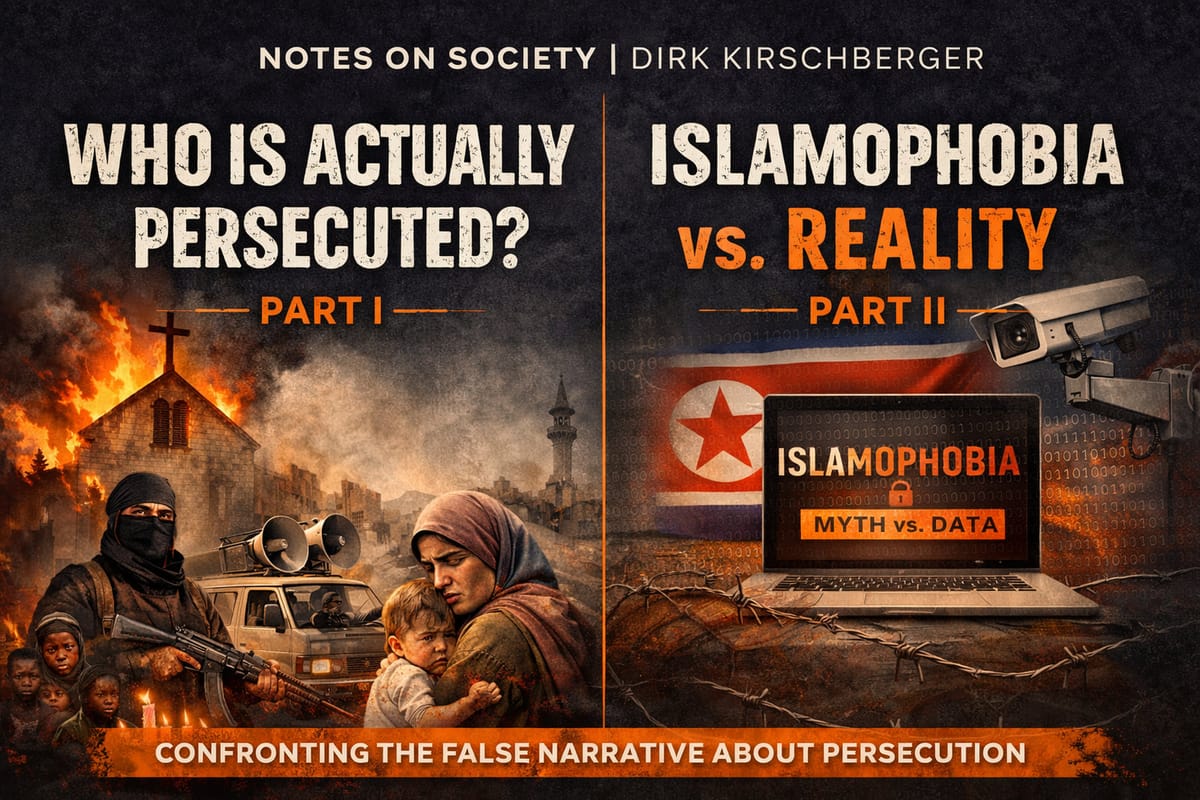
In Western discourse, one accusation shuts down debate faster than almost any other: Islamophobia.
It is invoked reflexively — as a moral alarm bell — whenever uncomfortable facts are mentioned about religious violence, ideological extremism, or intolerance. Yet the term is rarely examined against empirical reality.
So let us ask a simple, factual question:
Which religious group is actually persecuted worldwide — systematically, violently, and across continents?
The answer is not politically fashionable. But it is unambiguous.
The Data We Keep Ignoring
According to the latest World Watch List published by Open Doors, Christians face severe or extreme persecution in more than 50 countries worldwide.
In 15 of those countries, persecution has reached the level classified as extreme — the highest category.
This includes:
- imprisonment for faith
- forced conversion
- destruction of churches
- exclusion from education and employment
- abduction, rape, and murder
These are not isolated incidents. They are systemic patterns.
There is no comparable global index showing Muslims being persecuted as Muslims on a similar scale. Not because of bias — but because the data does not support such a claim.
Where Muslims Are Persecuted — and Why That Matters
Yes, Muslims can and do suffer persecution in certain regions:
- Uighur Muslims in China
- Rohingya Muslims in Myanmar
- Muslim minorities facing discrimination in parts of India
But these cases are regional, political, or ethnic in nature. They are not the result of a global, religion-based suppression of Islam.
Crucially, they occur despite Islam being the majority religion in many of the same countries where Christians are persecuted.
This distinction matters.
The Structural Asymmetry No One Wants to Discuss
Christians today are often:
- religious minorities
- targeted because of their faith
- persecuted by states, militias, or religious extremists
- punished or killed for converting away from Islam
Muslims, globally speaking:
- are not a persecuted religious minority
- rarely face punishment for converting to Islam
- often live in states where Islam is legally or culturally dominant
Criticism of Islam in Western societies — however uncomfortable — is not persecution.
Debate is not oppression.
Speech is not violence.
Conflating the two is intellectually dishonest.
Why the “Islamophobia” Narrative Persists
The accusation of Islamophobia serves a function:
- it creates false moral symmetry
- it deflects attention from religiously motivated violence
- it silences discussion by reframing facts as prejudice
Most importantly, it allows Western societies to avoid confronting real victims — because acknowledging them would require uncomfortable political clarity.
Christians do not fit the preferred narrative of victimhood.
They are inconvenient.
Reality Is Not Negotiable
The world’s most persecuted religious group today is Christian.
This is not an opinion. It is measurable reality.
Denying it does not protect Muslims.
It does not promote tolerance.
It does not advance human rights.
It only protects ideological comfort.
And reality, sooner or later, always breaks through ideology.